Readers!

Please enjoy these blogposts, written between 2011 and 2015. Another blog is on the way.

Saturday, August 15, 2015

Some Considerations When Telling It Slant or Otherwise

Our two teachers at Ty Newydd--Robert Minhinnick and Jay Griffiths--offered us welcome reminders about what makes good writing and new ways to think and write about a world suffering from climate change.
Minhinnick's New and Selected Poems 

Minhinnick's and Griffiths' work and teaching:

Minhinnick has made a lifetime commitment to both climate activism and poetry. He has been called "the leading Welsh poet of his generation." You can hear some of his poems here and at other sites online. He has also published essays and, more recently, fiction. In his teaching, he emphasized such fundamentals as including detail, the more particular the better, making full use of our memories, and letting strong diction stand alone, without modifiers.


Griffiths is better known in the U.S., partly because of her columns in the magazine Orion. Her book Wild: An Elemental Journey (not to be confused with Cheryl Strayed's Wild) is a memoir about visiting some of the last wild places on earth and an argument for leaving them that way. Some of her other works: A Sideways Look at Time, and Kith, about the modern child's need to meet nature unmediated. A paperback version of Kith will be published soon in the U.S as A Country Called Childhood: Children and the Exuberant World.

Her teaching of fundamentals centered on point of view--how what is seen changes according to who is seeing it--and on something she calls a work-in-development's arrowhead, where its focus is, where it is tending. The arrowhead of A Sideways Look at Time, for example, was the "politics of time." Jay wrote those words on an index card. In fiction, she said, finding the arrowhead is easier. What does the protagonist want? What obstacles are in the way of her getting it?

In putting together a book of poetry, Minhinnick said, one keeps in mind a theme or controlling idea. He prefers individual poems, however, to avoid summing up, to gesture toward continuing. 

Writerly intention and tone when climate change is the subject: 

Griffiths led a discussion suggested by something one of us had said (it wasn't me--I'm not this smart), that climate-change writing, climate-change art, is the opposite of art about war. War poetry is a poetry of reproach, she said. It looks backwards.

Must climate change art look forward?

Minhinnick stressed that the earth, and even late-arriving humans, have already experienced climate change more than once. The difference this time, Griffiths argued, is that the climate change has been caused by us. It's anthropogenic. (Minhinnick: "That may be, but I don't want to see the word anthropogenic in a poem!") 

Should art about climate change also be about reproach?

One of the roles of being a writer is being a messenger, said Griffiths. 

Minhinnick reminded us of Auden's "September 1, 1939," which asserts that all a poet can do is warn: "All I have is a voice/To undo the folded lie." What we write about should contain an element of warning, Minhinnick added, just as long as it's not black and white, as long as it's not telegraphed.

I'm not sure which teacher offered the following, but I think it was Griffiths in the first case and Minhinnick in the second. 

Writers need to distinguish between the fire in the belly that makes us want to get something across because people need to hear it, and the fire in the belly that makes us want to say something because we want to, or need to.

It is always easier to change someone’s mind in the dark. When light is shined brightly on particular readers, they tend to hide.

Beliefs about climate change: 

I figured you would be curious about this.

Griffiths holds that we in the West will face trouble due to climate, but that an "honest calmness" is justified. We have the means to temper climate effects, unlike the poor inhabitants of countries like Bangladesh. Griffiths acknowledges the injustice of this: the West is largely responsible for climate change while the whole world suffers from it.

Minhinnick is optimistic, period. He offers no argument for his optimism beyond his resilient nature. I feel now that he might justifiably have quoted the last lines of "September 1, 1939":

May I, composed like them
Of Eros and of dust,
Beleaguered by the same
Negation and despair,
Show an affirming flame.

(My own views about climate change haven't altered much over the last couple of years. I believe climate change is accelerating toward catastrophe, and that few if any human beings will survive. If we act to minimize the damage, we'll have to do it soon. We know enough to move forward right now. More science may be helpful, but what is required is something else--a capacity for love and courage that might emerge from new stories, new art, and a new humility about our species.)


More to come

I learned almost as much from my fellow students as from my teachers about indirect approaches to writing about climate change. And I'd like to share Griffith's wisdom about my own sketchy thoughts about a book to come. 

Thursday, August 13, 2015

Telling It Not Slant


Climate change is not the only kind of disaster that could bring our species to an end (as it already has many of our fellow species), but its special genius is that it can generate other catastrophes—disease, war, starvation, thirst, mass migration, fire. 

I’m sure you’ve read more post-apocalyptic fiction than I have. Not all is modern. Mary Shelley’s novel The Last Man, for example, published in 1826 and set in the 21st century, follows well-born refugees who flee from a plague-ridden England to the European continent. But if you’re a science fiction fan—these days it’s often called speculative fiction—I know you’ve read a lot more futuristic tragedy than I have. I’m more interested in the near than the distant future, however. I’m afraid I won’t be strong enough to face it.  If I can write about it, if I can fully imagine characters who do face it, I might be able to locate what so many people, including my classmates in Wales, have found lacking in me, some small measure of hope, or maybe courage.

Firefighters today, 70 miles east of Sacramento, where I was born.*
Here are some thoughts I had during the workshop. We didn’t discuss them—I didn’t have the chance to bring them up--but we talked about plenty of other, slantier things. I’ll get to those.

Climate can function as the setting of a story.  Settings are traditionally about mood. A stormy climate on the one hand or a quietly dying planet on the other (food crops unable to survive, people and animals dropping off) would establish a different intensity of mood than the foggy streets or deep forests of fiction set in the present. Stories like this could be about love affairs, home invasions, the loss of fortunes, or just about anything else, with climate change pushing in around the edges, serving as a reminder, more potent than we’re used to, that life is short.

I can’t think of an example of this kind of book right now—can you?—but I believe it’s the kind I’d like to write.

Climate change can also be the engine of the story. This is the way it’s being used most often, as plot. The action is the characters' attempt to survive.

1)   The story can begin after a definitive catastrophe, as in The Road, Benjamin Percy’s new book, The Dead Lands, Emily St. John Mandel’s Station Eleven, or James Kunstler’s A World Made by Hand.  A few human survivors must remain; otherwise, no story.

(But pick up The World Without Us by Alan Weisman, a nonfiction book that predicts in detail what the earth might look like and how it would change in our absence if humans died all at once.)

Survivors might be building new communities, as in Kunstler’s upstate New York, or living out their days in struggle, as in The Road.  In Station Eleven, the goal of the Shakespeare company whose exploits we follow is not just maintaining life, but transcending it. Its motto is “survival is insufficient.”

The world before these stories start is sometimes visited in flashback. In Station Eleven, the back story is only a quick hop away, achieved without a lot of explanation, since many of the characters were in the same place the night the epidemic began, at a performance of King Lear in Toronto. We get a sense of the lives they’ve led before the disaster by witnessing how they behave themselves right before trouble comes, and what they do when it strikes. After that they head off in different directions, coming together again, some of them, as fate (and the author) determines.

2)   The story can start now, or even twenty years ago, and move forward steadily into the near future. I’m happy to have an excuse to bring up one of my favorite books of the last few years: Lauren Groff’s Arcadia. Groff sets us down in an American commune formed in the 1960s, as seen through the eyes of one of its children. Over the course of the book, the older generation mostly dies off, and the kids have kids of their own. We see this second group of parents and children a few years from now, living in a city, after the commune has been mostly abandoned and when epidemic illness begins to take its toll. We see the land on the commune change, too.

What we don't see is some huge power struggle, some evil genius who's trying to take over the settlement, as in Kunstler's book and Percy's, even briefly in Mandel's. (Don't ask me about The Road. I've never had the guts to read it.)

The great thing about the strategy of stretching a timeline from now into the future is that when the characters are faced with hardship of a new kind, we already know how they faced previous challenges. We know them deeply.

More later.

Every commune needed one, but my friend Ruth owns one now. She drove me to the hospital in it. I think hers was made by Toyota. 


*Photo credit: International Business Times


Wednesday, August 12, 2015

Slanted Landings, revised

Many Brits greet you with the phrase, "You all right?" This is to allow a yes or no answer, rather than force you to consider a whole spectrum of responses. So a new English friend explained to me.

My first reaction to this greeting was to think, "Why? Don't I look all right?" But I answered yes, or I'm fine, or something like that, and passed the test. If I'd answered no, I suspect that someone in the vicinity would have offered to help. I say this because when I fell down the stairs in Wales the other night, landed on glass, and produced a great deal of blood--in other words, when I was not one bit all right--a whole squad of people hurried to help me.

I'll try to make this quick because I'm supposed to be discussing how to write slant about climate change. I'm going to do that, maybe tomorrow. I came away from the class with some ideas that, vague as they are, might ignite less vague ideas in you.

On the way up the slanted stairs to my room--the central structure of Ty Newydd is 600 years old and has its quirks--I lost my footing and somehow turned 180 degrees, or maybe I changed my mind about going up and turned on purpose to take my glass to the kitchen. I can't remember this moment very clearly. Either way, I tumbled down 8 carpeted stairs, landed on my face on the now broken glass I was carrying, and cut my face deeply over my nose. More blood than I've ever seen. The ambulance driver walked in and said, "Has there been a massacre in this house?"

By the time the National Health Service was finished with me, I had nine stitches over my nose, two in one finger, a very impressive black eye, and some scratches and bruises. But that was all. I was wearing my glasses, and I have to tell you that when the optician says "safety glass," he or she really means it. My glasses are bent beyond saving, but the lenses are 100% intact. I don't like to think what would have happened if they'd broken. Two of my stitches are a nanometer from the corner of my eye.

While the ambulance was on its way, one of my classmates, Ruth, the quietest among us, held me and collected the blood on towels, toilet paper, whatever the other women could find, as fast as they could find it. Others supported my back, gathered up my things, and so on. Then Ruth followed me in her van to the hospital, about 40 minutes away in Bangor, stayed up all night with me, and drove me home in the morning. Forget Queen Elizabeth. Ruth is Britain's true royalty. The others comprise her idiosyncratic family.

The NHS was slow but good, and charged me nothing. Imagine.

Everyone was very kind to me when I got back to the house. They didn't want me to be alone there on the weekend, and I think they made the right call. I wasn't moving very fast, and it would have been difficult to organize my meals, wash my bloody clothes, etc. Merryn did all these things for me.

My teacher, Jay Griffiths, invited me to spend the weekend at her house in South Wales, but I didn't think I could sit up for a two-hour car trip. As it turned out she had a breakdown on the way home. But how wonderful of her. 

I didn't stay at Ty Newydd for the second class I'd intended to take. I'm a troubling sight. I'm in Manchester now, holed up for a few days. I suppose I must have replaced all the blood I lost by now, but I still feel shaky. I'm wearing my sunglasses indoors and out. I avoid contact because I don't want any stranger to say, "You all right?" I'd be tempted to take my glasses off and tell the truth.

I've done some thinking about why this happened. I'd been up and down those warped stairs maybe 20 times before I fell. I knew they were "dodgy" (one of my favorite Brittisms). But I was also very tired, having done too much that day, walked too far, felt a wave of emotion during the workshop that morning that left me in tears, and drunk, over four hours' time, three small glasses of wine. I'd been feeling uncomfortable in the group, too. I was either the most pessimistic member when it came to climate change or the least in denial, and I felt a lot of pushback. I was also the only American. If you've done any traveling in the last, say, 50 years, you know what that can mean. We have pissed people off. A lot. Last but hardly least, the EMTs (I think they're called something else in Britain) commented that I was on a lot of medication--antidepressants, meds for restless leg and low thyroid. They blamed American doctors for this, but that was a stretch, I think. If anyone is to blame, it's me. Wine plus fatigue plus medication plus emotion plus slanty stairs equal a fall, I guess.  

A friend of mine, another kind of teacher, has suggested that my difficulties lately--I also had a car accident in June--may be about dealing with who I will be as the hardships of climate change accelerate. I'm undergoing some kind of spiritual transformation, she says, and I might as well surrender to it. It's out of my control anyway. She reminded me of the Buddhist saying, "When you're falling, dive."

Tuesday, August 4, 2015

Learning to Tell It Slant in Wales

This year, as you know if you've been checking in with my infrequent blogposts, I'm willing to go just about anywhere if it will help break the logjam in my head. I'm in North Wales for the next two weeks, taking two consecutive writing workshops offered by Literature Wales. This week's workshop is "Telling It Slant: Writing about Climate Change," and the tutors (that's what instructors are called here) are Jay Griffiths and Robert Minhinnick.

View of Criccieth Castle and the sea
It wasn't easy to get here. I flew from Vancouver, British Columbia (just over the border from my home in Bellingham, Washington) to Heathrow, now a labyrinthine shopping mall as much as an airport. After schlepping my baggage from one terminal to another, I missed my connecting flight to Liverpool, flew to Manchester instead, then took a train to Liverpool. The following day I boarded another train to Wales, to the town of Criccieth, on the wrist of the Welsh hand that reaches into the Irish Sea.

Once the train reached the Welsh beaches, vacationers climbed on and off in droves. Because I'd transferred to this line in Shrewsbury, England, I hung onto my window seat all the way to Criccieth. Across from me sat an amateur painter who travels to Wales every summer. He filled me in on the landscape and the beach towns. He talked at length about Welsh history and politics. All was friendly until, near the end of the trip, I told him I was traveling to take a class on writing about climate change. His face, his diction, the tone of his voice immediately altered: "We may be experiencing climate change," he said, "but I can't believe we caused it." He wasn't so chatty after that, a reminder that approaching this subject directly still doesn't work with most people. Hence the second half of this workshop's title, "Telling It Slant," which is borrowed from the Emily Dickinson poem that begins, "Tell all the truth but tell it slant/Success in Circuit lies."

Literature Wales holds its classes, one at a time, ten students per class, in a beautiful old house called Ty Newydd. Room and board (lovely food!) are included in the cost. I don't know yet how to write at a slant about climate change. In a day or two, I hope to have at least a clue.

Monday, June 22, 2015

Grieving

I spent the weekend before the Charleston church shooting in Providence, Rhode Island, attending a grief workshop facilitated by Carolyn Baker. Carolyn led us in a ritual in the West African tradition of Malidoma and Subonfu Some.
My beautiful teacher, Carolyn Baker.

One way Carolyn readied us for grieving was to tell us folktales while drumming. She usually began with something like "a long time ago or a short time ago or whatever time it was." Right away, because I couldn't place the story in time, I--I'll speak only for myself--could disengage some other habitual expectations. Where was it taking place? I didn't need to know. If a dead father walked into a village, weren't there dead fathers everywhere? Villages everywhere? If a long-delayed tear was shed by a man and drunk by a woman, couldn't that happen in my town, and wouldn't my town be changed by it?

With the drumming serving as a sort of universal pulse, I could have been sitting anywhere in the world or living in any time. I could accept that caring for an ancestor required picking the maggots off one side of his body and polishing the gold on the other side. Of course it did. Why wouldn't it?

I won't tell you much about the grief ritual itself except to say that it was simple, it lasted a couple of hours, and for most of us, it "worked." That is, we were able to sink into the experience, feel our grief fully and release it, achieve a sense of emptiness and ease. For now. Grieving must be done regularly. I will need to grieve again before long and will have to find a community in my home town to grieve with. You can't do this kind of work alone.

We'd all come to Carolyn's workshop with different losses to grieve. For me, and for some others, I think, family losses and the slipping away of a livable planet intersected as one loss. I was able to cry for both.

We grieved in the presence of photographs of our ancestors. I'm only beginning to look into how people outside western communities think of their forebears. In my experience, when a loved one dies, a service is held, his or her life is remembered and celebrated, we say goodbye, and the body is cremated or buried. In other parts of the world, there is no goodbye. Those who have died are still part of the community, maybe the most important part. They strengthen the living, grieve alongside them, advise them, and require their attention.

The shootings in Charleston on June 17 didn't surprise me very much.  I've been there, seen the elegant colors its bricks are painted, bricks made by slaves from the clay of alligator-infested tidal rivers. I've visited the slave market, which has been turned into a shopping center where crafts once practiced by slaves are sold as artsy souvenirs. I've seen the barbed wire placed on top of the walls around some of the oldest homes after the slave rebellion in Haiti in1791. Charleston whites were scared to death by what happened in Haiti, and they must be scared still since that barbed wire is regularly refreshed. I've looked out on Fort Sumter in Charleston Harbor. Confederate artillery fired the first salvos of the Civil War on the Union garrison there. I've seen the Confederate flag flying everywhere, sometimes just above what's called the Gadsden flag, popular these days with the Tea Party.

Gadsden Flag
Tourists crowd Charleston's streets. Its venerable, perfectly preserved hotels fill up with destination weddings. The restaurants are so epicurean I don't have the vocabulary to describe them. Charleston's permanent residents are white.

Black people, descendants of slaves, live around Charleston, on its outskirts. The Emanuel African Methodist Episcopal Church, dating from the time when the slaves of Charleston proper needed a church near where they lived, is in white territory. How could a kid like Dylann Roof--imagine his ancestors if you dare--be expected to tolerate that?

I live in a bigger world since Carolyn's workshop, but it's a dying world, a little closer to death every day. I will need to grieve regularly. These last few days I'm grieving for the people a white supremacist killed, for their grieving ancestors, and for their grieving children.

Saturday, June 6, 2015

All Things Superhero

I'm an explorer without a compass these days, writing about what happens to be on my mind.

Thirty years ago, when my older son, Alex, was five or six, he made a habit of waking up early, an hour before his baby brother, and waking me up, too. When the coffee was ready, I sat beside him on the sofa and read to him from a collection of Spiderman comics strung together and reduced to a mass-market paperback. The print was minuscule. At 6 AM, even with my glasses on and downing coffee at a good clip, the words in the speech balloons were hard to bring into focus. But the effort was worth it. Being there with Alex, his head leaning against my left arm, the smell of his hair, the nap of the corduroy sofa, my old red bathrobe--I love remembering these things.

It must have been important to Alex to spend that time with me, but I'm pretty sure that the book was more important. He was riveted by Peter Parker, the radioactive spider bite, the boy's transformation to Spiderman and his ensuing heroics. Alex's inner life, his backyard play dates with himself, were, right up until puberty, all about superheroes. I've come to believe that the Spiderman book, the boxes and boxes of comics that until recently were stored in our basement, the never-ending series of superhero TV shows and movies, that all things superhero helped Alex, who was three years old when his parents divorced, reknit his psyche.

Am I wrong or is the volume of superhero stuff in our culture still growing? Is there ever a time these days, for example, when a Marvel or DC comics hero isn't sailing across a screen at the multiplex?

I've never read Joseph Campbell's The Hero with a Thousand Faces, but I think I know the basics. Heroes go on journeys to lands where supernatural forces are at work. They face obstacles, internal and external, in order to bring back some essential wisdom to their communities.

One man (usually a man) steps up to attempt the heroic task because he's decided, for one reason or another, that he's the man to do it. If you've been bitten by a radioactive spider and can suddenly swing from skyscraper to skyscraper, stepping up might be the obvious choice, but if you're a hobbit, half the size of everyone around you, and you've never been away from home, it's a little harder to find the courage to say, "I will take the ring though I do not know the way." Luckily, Frodo doesn't have to go by himself.

I've always been suspicious of the idea that we need heroes. Wouldn't it be better if we ordinary, imperfect people banded together, encouraged and instructed each other, shared our intuitions and ideas? Wouldn't that improve our chances of surviving the superheating of the earth more effectively than the sudden appearance of super-smart, super-powered heroes? What if we stopped waiting for a savior and stepped up ourselves?

Okay, maybe at this late date, this eleventh hour, we need both ordinary and extraordinary people.

I just read Ben Percy's new novel, The Dead Lands, a dystopian fantasy in which a few people set out from what they believe to be the only surviving human settlement in North America toward a land of plenty that may or may not exist. Most go not for heroic reasons but because the settlement is a horrific place governed by a vile man. Risking their lives outside its walls feels better than staying put. One character, however, is chosen for the trip, summoned. His name is Lewis Meriwether.

All the party have impressive skills, but Meriwether and one other are armed with special gifts. Unfortunately, these gifts don't apply in every situation, and they are dwarfed by the sequence of dangers the group encounters. Imagine the Donner Party fighting monsters created by radioactive fallout--giant bats, bison, bears, and spiders. There are lots of reasons to like The Dead Lands--interesting ideas, consistently great writing, fully imagined female characters, and some really scary shit--but the main reason I liked it is that the hero's journey is ultimately successful because of mutual help and developing trust.

This is not the first time Percy has interrogated the idea of heroism. See, for example, his short story "Refresh, Refresh." But he hasn't given up on the solo crusader either. He's writing the comic Green Arrow now. Number 41, just released, begins a story set in a foggy, failing Seattle. Black men are getting murdered at a terrifying pace. Timely.


Thursday, May 28, 2015

Creaking and Yielding

A wonderful book

"We are jury-rigged creatures, psychically; one cannot start down the road of undoing the self's slapdash constructions without the whole structure starting to creak and yield."

                                -- Tim Farrington, in A Hell of Mercy

What took me to Mexico in February, and then to Mallorca? Dryness. Immobility. Exhaustion, usually following a day of doing almost nothing. When you get to this place, trying something different, unlike anything the "you" you know would do, begins to seem like your only move.

Since Mallorca, I've been suffering from a bad cold, as bad as the colds I used to get from hanging out with little kids who stuck their fingers in my eyes and up my nose to show me how much they liked me. I've stayed in bed for a few days. Now I'm sitting in my office wondering what's next. What new rock-solid beliefs about myself are going to crumble, and who will I be when they do?

What really worries me is that I'll manage to glue myself back together again before I'm finished falling apart, that my box (see my last blog) won't expand, may even contract, that I'll stop these changes before they go too far. Where would be too far? The place where I feel no ground under my feet. Where I grasp (despite everything I've been given) the utter emptiness of my life. But that's where God lives, I suspect, and where whatever I do will come from the deepest place in me. I have to go to that place if I want to do anything during the last quarter of my life--and what may turn out to be the sunset years of human life on earth--besides watch television.

I've signed up for the next step after Expand the Box: Possibility Labs. These will happen for me in late June right here in Washington State. In the meantime, there's the little problem of my vocation, what I do when I get up in the morning. For the last 10 or 15 years, depending on when I start counting, this vocation has been writing. I've published some stories and put together a story collection that I haven't tried very hard to get into print. Not much to show for 10 -15 years.

I've started several books too, of course. The two that are choking my inboxes right now are an attempt at autobiography and a mystery. At the moment neither seems worth investing in. The first is the story I've been telling myself about my leaving-home experiences, the transition from my family's house to a freshman dorm at Stanford. How I understand those years will certainly change in the near future. The mystery is an effort to write something marketable, but no one I've shown it to likes it much. I don't know if I've learned not to like it from them or if it really isn't very entertaining.

I guess I'll start with cleaning up my space. Books are piled everywhere, magazines are stacked waist-high. I've already stripped my bulletin board.

Then I'll sit down and see what happens.

Tim Farrington again:

"I kept coming back to the desk every morning anyway, and I am convinced, in retrospect, that this is a key element in the dark night reaching critical mass: having something, anything, that you will continue to do just for the doing of it, long after every possible reason to do it has evaporated, a leap of faith you are willing to take even after it has become clear that it really does just go straight off that cliff and you're not a hero or a saint or anything even remotely edifying, you're a freakin' idiot and they're going to spell your name wrong on your gravestone."

Thursday, May 21, 2015

Two Stories about Me

I just returned from Mallorca, an island in the Mediterranean off the coast of Spain. The Playa de Illetas, one of Mallorca's resort areas, is tidy, tasteful, flowering, breezy. The sea has that aqua-to-blue-to-aqua thing going on that I first saw in Cancun a few months ago. Yet I took no photographs. The photo here is a promotional one.

I traveled to Mallorca to attend a personal training course called Expand the Box, based on the work of Clinton Callahan and his colleagues. Clinton and Marion, our trainers, taught us a different way of thinking called Radical Responsibility. I'm already sounding like someone I don't know, a narcissist who takes an expensive flight to a gorgeous place to self-improve. But that's just a story. We, about 30 of us, heard a lot about stories over the five days of the training.

Some facts first, then the two stories. I should warn you that I'm not entirely sure that what follow are facts. I'm going to be practicing separating facts from stories for some time to come.

I'm the three-year-old in the middle.
I come from working-class parents whose histories left them fearful. My brother and sister are 11 and 8 years older than I am and were entering adulthood and leaving home about the time that my father became very ill. He was 63 then, my mother was 48, and I was 10. My mother went to work at night so that either she or I would be available to care for my father.

I did well in school, left home at 18 for college on scholarship and returned to live in my hometown afterward. I married once, then twice, and had my first child. My siblings moved to other states and visited my parents occasionally. During my twenties I spent a lot of time in the car driving from my home in Palo Alto, California to my parents' mobile home in Sacramento. After my son was born--I was 27 then--he came with me.

My parents died 16 months apart, my father when I was 29, and my mother when I was 30. My brother and sister came to see my parents during their last illnesses, but left quickly. For all intents and purposes I was the child responsible for visiting my parents regularly during their last decade and, toward the end of it, for interacting with their doctors and sitting at their bedsides.

The story I told myself before Expand the Box: (Once upon a time in the galaxy far, far away that I call my childhood) my parents conceived me, long after their other two children, so they would have a child to care for them in their old age. They were proud of my successes in school but not entirely comfortable with them. Like the parents of children described in Alice Miller's books, they sometimes discouraged me, either to protect me from disappointment or to keep me from going too far away from them. I was what is often called a parental child, caring for them more than a child should be expected to, until I went to college. At college, the growing up I couldn't do at home, the "normal" experiences adolescents have in our culture that I had skipped, made life difficult.

My siblings had their own problems and forgot or resisted thinking about mine. The chaos of my twenties--marriage, divorce, remarriage--gave them an excuse to view me as a person who would have been troubled even without taking responsibility for our parents. When they left me at the hospital during my mother's final days, they did this with clear consciences.

The story I am able to tell myself now: I was born into a family established in its ways, and I wanted to make a place for myself in it. I couldn't compete with my brother and was determined that my mother would treat me better than my sister, so I tried to be the perfect, shiny, smart and sometimes even a little bit pretty child. I used church teachings to convince myself that good works make you better than others, and hunkered down to do my parental child thing at home.

After college I didn't know what kind of work I wanted to do, and I was temporarily husband- and boyfriend-less, so my father's first heart attack provided an excuse for me to retreat to Sacramento. Visiting and caring for my parents became the one steady element of my twenties, the one thing that made me feel like a worthwhile person. During my parents' final illnesses, I conveyed in one way or another (I conveniently can't remember exactly how) that it was all right for my siblings to leave me with our parents. I would do the work. They might not be able to, but I was and I would. When my mother died and I sat alone watching the undertakers zip her body into a black plastic bag, I told myself that I had won. I was the best of my parents' children. I always had been, and I'd gone the distance. I had done the work until it was finished.

Which of these stories is true? I learned in Mallorca that it doesn't matter. What matters is which story makes me feel as if my life belongs to me. If I need to reframe my story to say that my nearest and dearest didn't use me as a crutch so much as I became one in order to feel good about myself, then that's what I do. Because I feel stronger. Because my box becomes bigger. I'm able to stand up straight in it, for example.

I've been trying to think myself out of my good-girl role for decades. It's not a comfortable home for an adult. A sticky, pink residue has clung to me day in and day out, a little like the stuff that forms the bathtub ring in The Cat in the Hat Comes Back. You can take a bath in that tub, and scrub and scrub, but you won't get clean.

I live near my siblings now, and recently I began trying to talk about how they let me down 30 years ago. You can imagine how these conversations went. I figured out pretty fast--and this conviction was reinforced in Mallorca--that I couldn't work through this stuff and let go of it by talking to them, not armed with all the anger I still felt. I had to wade back into the anger on my own and hope I could start fresh with my siblings on the other side. I believe I stumbled on exactly the right program to help me do that. Thank whomever.

Read about Expand the Box at nextculture.org. Clinton Callahan's most recent book, Directing the Power of Conscious Feelings, will take you some distance toward grokking this stuff, but I recommend showing up for a training. For trainings in the U.S., see nextculture-us.com.

Sunday, March 8, 2015

Mexico: Not Quite a Round Trip

Spoiler alert: This post--the last about my trip to the Yucatan--is going to be a little personal, maybe even Hallmarky.

You know those cards that feature a riderless horse racing along a beach? If the card is for sale in the red states, the message inside will say Be joyful! God has plans for you. In the blue states, the card will either be blank (so as not to constrain the sender's freedom of expression by putting words in her mouth) or will feature a fragment of a Rilke quote: Live the questions--and . . . enjoy! 

I live in a blue state, always have. I wouldn't survive in a red state. I'd piss so many people off by asking personal questions and teasing out hypocrisies--in my maddeningly polite but actually very aggressive way--that I'd be ostracized within a week. My M.O. in life has been to poke holes in others' certainties while respecting the fundamental value of the people that hold them. I've been argumentative, but most of the time I've also been generous. I've tried to show up when I could help. And I've been honest, usually, about my own failings. I've fought the good fight, in my small way, for open-mindedness and inclusion, for kindness, for not having to be perfect.  Live the questions! I've said. It's not so bad! Enjoy!

Meanwhile, in my heart of hearts, I've nurtured some pretty dreadful certainties of my own.

One version of the infamous hockey stick graph. Not good news.
Since I read The Limits to Growth in the 70s, it's been pretty clear to me that economies couldn't keep growing, that we couldn''t keep buying whatever struck our fancy, that we shouldn't look for heroes or try to be heroes ourselves but learn instead to lead humble, useful lives. If we failed to turn our thinking around, our cultural assumptions, we would ruin the planet we lived on. And we have. I have. But that's not one of the certainties I referred to above.

Those certainties follow: There is
  • No point in trying to live a satisfying life between now and the predicted 50-gigaton release of methane that will wipe us all out within years. 
  • No point in continuing to grow up, learn, heal.
  • No point in writing my stories about generosity to self and others. (Only a tiny fraction of them ever get published anyway.) 
  • No point in looking for people who see what I see (there are a lot more of these people now than there used to be) and clinging to them. Who has that much energy?
  • No point in feeling any feeling that doesn't take our impending doom into consideration.
  • No point in grieving that doom in a way that might release me from the inchoate haze I've been in.
  • No point in opening the door to see what's outside this poisonous culture. The door is stuck. And what if I manage to open it and then lock myself out? If I change my circumstances before the methane changes them for me, what if the new life is too hard, too exhausting, too unpleasant? What if I'm not up to it? 
Carolyn and Anyaa
Some of these certainties aren't so certain, you'll notice. They are questions but not the kind that you live into. These are the kind that stop you cold.

Where is Mexico in all this? I met some people there who have found a way to carry on, to make change, to invite others along, to live today, no matter how many more todays we have. (Live the questions, and . . . enjoy!    But also grow and act.)  I met Israel MayCarolyn Baker, Gary Stamper, Anyaa McAndrews, Clinton Callahan, and other lesser known but equally fabulous people. I left and came home, but home doesn't look the same.


Wednesday, March 4, 2015

Learning from a Shaman, #4: Table Fellowship in Israel's Backyard

In the middle of our week in Izamal, shaman Israel May invited us into his backyard, next door to an age-old Mayan temple, for a traditional meal.

He and his family had prepared pibil, the generic name for food cooked in a pit or "pib." Our pibil was a dough made of masa and black beans wrapped in banana leaves. Israel had set many of these banana-leaf packages, along with squash, tomatoes, and citrus fruit, in a ceremonial circle ringed with flowers. When the rocks lining the bottom of the pit were the right temperature, we each chose an item of food and handed it to Israel. He lifted the food and our joined hands toward the sky, placed the food carefully on the rocks, then covered the food with sacking and the red dirt we'd seen everywhere in the Yucatan. It would take a couple of hours for the food to cook, so we got back on the bus and drove to the Ake ruins.

Ake is an early classic city, built centuries before post-Classic Chichen Itza and Tulum. It has been only partially excavated, but much grandeur has already surfaced. There was a school nearby, too, and it was good to hear children's voices. There was something else, too--dwellings, not of kings and priests, but of common people.

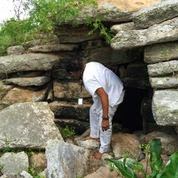
Israel showed us two caves set about 20 feet apart on a hill. When he was halfway up the steep path to these dwellings he said, "Stop here! You'll feel something right here." I didn't, and it made me sad. But on top of the hill, sitting near one of the caves, I began to imagine the people who had once lived there, smaller and darker-skinned than I am but otherwise the same, women, in particular, who cooked out of doors, gave birth, looked after their children, stored the bones of their dead, and themselves died. I felt something then.

By the time the bus returned to Israel's house, with the temple next door, the pit holding our food, I was in a place to appreciate what I was being offered, the sacred gift of friendship.

Israel and his brother excavated the food, laid it out on a small table in the garden, and we ate sitting on rocks. Nevertheless, we were practicing table fellowship. That's how it seemed to me.

If you've avoided church pews most of your life, you'll have to forgive me for this comparison. Christianity is where I started. I'm still trying to separate what's beautiful in it from what's hideous, but it's impossible to set aside entirely. An old friend once said of the effort to walk away, "It's too deep in me."

What I mean by table fellowship is this: Jesus invited the marginal--tax collectors, prostitutes, menstruating women, foreigners, the sick, and people too poor to pay for required sacrifices at the temple--to eat with him. (Unlike Israel, he didn't cook the meal himself. Remember Mary and Martha? That whole quagmire? Others cooked. Women cooked.) But by eating together, sitting down and breaking bread, he showed to those who were either temporarily or permanently not "our kind of people" that as far as he and the god he believed in were concerned, they were unblemished; they counted; they belonged.

In Mexico, I sometimes felt as if I were marginalized--by the people I knew least, and whose opinion I valued most, the Mexicans who lived there. This was most disturbing in Cancun, where our trip started and ended. Cancun is infested by fancy hotels and beach houses, clubbing opportunities, and giant statues of Spiderman. Apart from the mesmerizing water, aqua to indigo to aqua again, Cancun is Las Vegas South.

Mexican service workers make their living there by catering to our tastelessness. I saw resignation on some faces and barely disguised rage on others. In Izamal, on the other hand, people were friendly, waving at us as they bicycled by on the street, or smiling up into the windows of our bus. They seemed glad to see us, or maybe just glad to see Israel, who seemed to know every last one of them. Yet even in Izamal I felt foreign, ignorant, intrusive, and a lot of other unpleasant things.

The meal Israel offered us relieved me of those feelings, at least for a while. Blessing food by raising it up and eating it together? A Eucharist. Burying food in the ground and digging it up later? A sort of resurrection. Doing all this outdoors? Fellowship with people through the ages who lived simply on the land. A vision of our own future, maybe, if we're lucky enough to have a future.

******************

Trip photos by Tracy O'Neill. Photo of Ake temple from Wikipedia.

Friday, February 27, 2015

Interlude: A Bowl of Raspberry Oatmeal

Carl Sagan once said something along these lines: If, after the resurrection, Jesus had ascended into heaven at the speed of light, he still wouldn't have cleared the galaxy.

Maybe that's the wrong metaphor for what happened to me this morning, but I'm going with it anyway.

For a long time I've been trying to see the big picture. You need a high perch to see what's happening to the earth as a whole, to wrap your mind around humanity's non-future, to consider what, if anything, you might try to do about it. That's why I traveled to the Yucatan. That's why I've visited certain websites way too often over the years. That's where I've been living, in a shaky house in a very tall tree that has nevertheless felt not tall enough.

How far up would I have to go? How tall would my tree need to be?

Since Wednesday night I've been hanging out at my niece's house. She's been in a Seattle hospital having surgery. Something needed to be taken out, and that something needed to be biopsied. It wasn't cancerous. Hallelujah. She'll be coming home in a day or two, and that's good because her three daughters miss her a LOT. They miss their father too, who's with my niece at the hospital.

This morning I asked the middle daughter, Harper, who is ten (I think) and has seemed to be the most rattled by her mother's absence, what she wanted for breakfast.

"I want blueberry oatmeal," she said, plain as day.

Since my niece and her husband adopted Harper--she was three at the time--her speech development has been slow. It's possible that she suffered some brain damage during her birth in China. Lately, though, she's been making fast progress. In any case, there was no mistaking "I want blueberry oatmeal."

I couldn't find any blueberries, but there was a bag of frozen raspberries in the freezer. "Is raspberry oatmeal okay?"

A grudging nod. She took a bowl out of the cupboard and placed it at the center of the kitchen island, which is where breakfast gets eaten in this very organized household.

I poured some raspberries into the bowl I'd put on the counter for my own breakfast, thawed them in the microwave, cooked the oatmeal on the stove, poured the oatmeal on top of the raspberries, and set the bowl in front of Harper.

She stared into the bowl, looking utterly appalled. Her younger sister. Hunter, said to me, "I think you were supposed to mix it together."

I handed Harper a spoon. "You can go ahead and mix it up."

She mixed it up and stared into the bowl some more.

Hunter, ever helpful, said, "Mom puts cinnamon on it."

I shook some cinnamon on Harper's oatmeal. Still she stared into the bowl. After a minute she pushed it away, stretched out an arm, and lay her head on it.

"Hannah," I said to the oldest sister, a teenager. "Help me out here."

Hannah said softly, "She's just being Harper."

And what did I do? I repeated those words loud enough for Harper to hear them. "She's just being Harper," I said--trying to figure out what was wrong, trying to reassure myself that it had nothing to do with me.

Harper, her head still down, started to cry. For a long minute none of the rest of us said anything, neither Hunter nor Hannah nor I.

"She doesn't like the bowl," Hunter finally suggested.

Then I saw right in front of me the bowl that Harper had chosen. I'd put her oatmeal in the one I'd chosen. I poured the oatmeal from my bowl into hers, and she ate it, all but the last bite, although the bowl wasn't the real problem.

When you're in a very tall tree, you can miss things, especially small things, things on the ground that require care. Being careful with small things is work worth doing in this terrifying, unprecedented time.

What does all this have to do with the Carl Sagan quote? Probably nothing. I've just always liked that quote.


Next time: A Shared Mayan Meal--What's On, and In, the Ground


Monday, February 23, 2015

Talking About Collapse in Mayan Territory

The Doomsday Clock, recently reset two minutes ahead, to 11:57.
We didn't talk about collapse--at least not much--and that surprised me.

During our week in Izamal, Israel was busy in the evenings. Sometimes he did bodywork for members of the group, but otherwise he was elsewhere. I wonder how much he would have said about planetary collapse--of our economies, habitats, and cultures--even if he'd been around. He seemed more interested in showing us ways to live based on spiritual principles sounder, or more deeply held, than our own.

If we'd traveled together longer, maybe we would have talked more about our feelings and plans in the face of collapse, but during our ten days together, we were busy looking at ruins, taking pictures, having adventures, and learning from our leaders new ways to feel stronger in these scary times. When we did approach the subject of collapse directly, I felt that most of us were holding back.

The topic of one brief conversation was how directly the Mayan experience applied to our own. The Post-Classic Maya of the Yucatan were in the end invaded and conquered by the Spanish. That didn't seem likely to happen to us, those of us who were Americans at least, armed to the teeth as our country is. Earlier Maya suffered from drought, overuse of resources, and stratified, top-heavy, disorganized societies. Those stresses did seem to apply to us. How did these Maya die in the end? Starvation, probably. No one wanted to talk about that.

I've had some experience talking to others about rapidly rising temperatures, the melting Arctic, the messed up Jet Stream, gridlocked government, the dying ocean and burning forests. These conversations have never gone well. I don't regret them but didn't want to repeat them on the trip, and I guess most of the rest of the group didn't either. Probably we already shared a roughly similar body of knowledge about these things. Some of us, I know, were trying to face up to the idea of near-term human extinction, a very rapid collapse caused by huge methane releases and probably already in progress.

But I was hungry to hear about individual circumstances, what people were planning to do, what was going on inside their heads. Maybe I should have said that louder.

Gary Stamper, for example, talked about his and his partner's situation in a loosely formed community with no children growing up to carry it on. He spoke as well about the impossibility of preparing adequately for "cliff events" such as a new, rapidly spreading virus or a currency collapse. I appreciated his honesty.

A gradual, stepwise collapse seems more probable to me. For that we have to band together in small communities, share, barter, help, look out for the most vulnerable. These strategies won't work in the long run--I don't think any strategy will save us--but in the short run, depending on community might be the only thing that will make life bearable.

Our six travelers from Germany seemed interested in the possibility that some of us might survive--if we can learn to live a different way. They train people in a remarkable program of personal development called Possibility Management.  I plan to learn more about that and about autonomous zones (see, for example, http://yubia.blog.com), a movement they are interested in fostering. I got the distinct impression, however, that Possibility Management begins with and insists on, if not optimism, a positive outlook. At this point I'd have to have a brain transplant to conjure up a positive outlook. A peaceful one might become possible, but a positive one, no.

Carolyn Baker spoke about collapse becoming a vehicle that would lead the willing toward a less egoistic state and ultimately to a transformation of consciousness. What that might feel like, no one can know. I've been pondering it anyway.

These exchanges pointed to a future none of us can see its entirety. Guessing, despite the flood of information finally coming out about trouble ahead, is also problematic. Since we are facing something the Maya did not face, something brand new and devastating in its emotional impact, the extinction of life on an entire planet, I guess it's not surprising that we have to look at it and talk about it a little at a time.

Before the trip, Gary wrote, "I think by going, I’ll be saying through the Mayan collapse and to the Maya, in a way I cannot do from home, that we are connected, that they are not alone. And neither am I."

I like that.

Tulum. The Maya couldn't go any further north without falling into the sea.